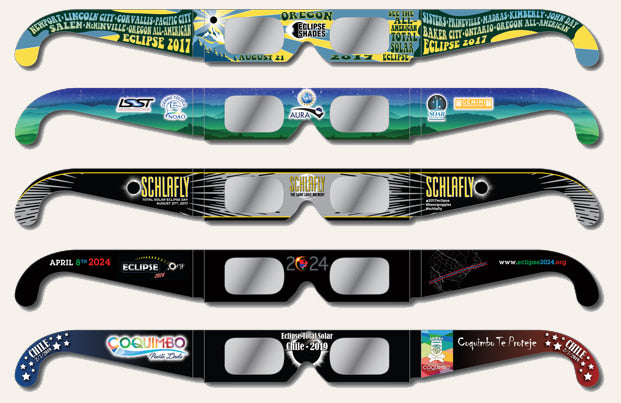
| A total solar eclipse is probably the most spectacular
astronomical event that most people will experience in their lives. There
is a great deal of interest in watching eclipses, and in the days and
weeks before an eclipse occurs, there are often news stories and
announcements in the media, providing information on what will happen, and
how to watch the eclipse safely.
Unfortunately, despite the best intentions, the news media often
provide inaccurate information on safe observing techniques. This is
especially true when the subject of protective filters for direct
observation of the sun is raised. Over the past five years, I have been
asked to comment on the safety of using devices such as floppy disk media,
multiple layers of space blanket (a very thin type of aluminized
polyester), compact disks (CDs) and metal coated polyester wrappers as
solar filters. There are now several manufacturers of solar filters
intended for both visual and photographic use who were not operating in
1981 when I first published solar filter data in Sky and Telescope
(August, 1981).
An invitation to participate in a NATO-sponsored meeting on solar
eclipse astronomy in June, 1996, prompted me to make spectrophotometric
measurements of a variety of solar filter materials and assess whether
these filters provide adequate protection for the eyes.
Retinal Burns
Solar radiation reaching the surface of the earth ranges from
ultraviolet (UV) radiation at wavelengths longer than 290 nm to radio
waves in the metre range. It is widely accepted that environmental
exposure to high levels of solar UV radiation contributes to the
accelerated ageing of the outer layers of the eye and skin, and the
development of cataracts. However, observing the sun with inadequate or no
eye protection results in "eclipse blindness" or retinal burns because the
eye transmits most of the optical radiation between 380 nm and 1400 nm to
the light-sensitive retina.
Exposure of the retina to high irradiance levels of visible light
triggers a series of complex chemical reactions within the light-sensitive
rod and cone cells. The resulting photoproducts damage the cells,
impairing their ability to respond to light, and in extreme cases can
destroy them. Depending on the severity of the damage, an affected
observer experiences either a temporary or permanent loss of visual
function. This photochemical retinal injury mainly occurs when the retina
is exposed to blue and green light. Longer wavelengths of visible light
and near-IR radiation are absorbed by the dark pigment epithelium below
the retina, and converted into heat which can literally cook the exposed
tissue. This thermal damage also occurs during extended exposure to blue
and green light. Photocoagulation destroys the rods and cones, leaving a
permanently blind area in the retina.
Each wavelength of optical radiation has an associated threshold
retinal exposure level that must be exceeded in order for retinal damage
to be observed - shorter wavelengths are more effective in that less
energy is needed. The danger to vision of inadequately protected viewing
of the sun is significant because light-induced retinal injuries occur
without any feeling of pain (there are no pain receptors in the retina),
and the visual effects do not occur for at least several hours after the
damage is done.
Because the threshold exposure levels for photic damage to the retina
at each wavelength of the optical spectrum are well known, it is fairly
simple to calculate the maximum permissible filter transmittance that will
provide adequate retinal protection from sunlight. The ratio between the
threshold retinal irradiance for light damage to the solar spectral
irradiance at each wavelength provides a starting point for this. The
worst case scenario assumes that the sun is at the zenith in a clear sky
(air mass of 1). The maximum permissible transmittance level of the filter
at a given wavelength can be arbitrarily set at between one per cent and
0.1% of this ratio to provide a "safety" factor. When this is done for the
waveband between 380 and 1400 nm, we find that a filter with a luminous
transmittance of 0.0032% in the visible spectrum corresponding to a shade
number of 12 provides "adequate" retinal protection during solar viewing.
However, this does not take into account visual comfort; for comfortable
viewing of the sun, a filter with a luminous transmittance of 0.0003%
(shade number 14) is often preferable.
Back
to Index
Measuring Filter Transmittance
Filter materials that were tested are shown in
Table 1. Solar filter materials were randomly selected from the
manufacturers' stock. The photographic film samples were purchased from a
local retailer, then exposed to full sunlight and developed to maximum
density according to the manufacturers' instructions. The smoked glass
filter was produced by depositing soot from a candle flame onto a glass
microscope slide. The other materials were obtained by random selection
from retailers' stock.
Transmittance measurements were made with a Cary 5 spectrophotometer at
5 nm intervals over the waveband 200 to 2500 nm, and the data were stored
as Lotus spreadsheet files. A rear-beam attenuator accessory was used to
reduce the noise level, but there was still a significant level of signal
fluctuation in the infrared (IR) and ultraviolet (UV) regions of the
spectrum. This is a common problem when measuring transmittance of
high-density filter materials.
Microsoft Excel workbooks developed in the Ophthalmic Standards
Laboratory at the School of Optometry, University of Waterloo, were used
to calculate luminous transmittance, shade number, and mean transmittance
in two UV wavebands (200 to 315 nm and 315 to 380 nm) and the near-IR (780
to 1400 nm). These calculations are specified in the American National
Standard Practice for Occupational and Educational Eye and Face Protection
(ANSI Z87.1-1989). The data are shown in Table 2. The spectral
transmittance curves for these solar filter materials are shown in the
accompanying figures.
Back
to Index
Relative Safety of Solar Filter Materials
Not surprisingly, there was a wide range in the attenuation of visible
light by these filter materials. Even among the "safe" filters, there was
considerable variation in transmission levels. For example, the
differences in processing methods and chemistry resulted in considerable
variation in optical density of the silver-bearing black-and-white film
emulsions. The double-layer filters had shade numbers between 11 and 16.
I have recently also found a wide range of optical density between
individual audio and data compact disks (CD and CD-ROM) because of
variations in manufacturing processes. Some compact disks have aluminum
films which are so thin that they appear semi-transparent at normal room
illumination levels. These CDs are unsuitable for use as solar filters.
Higher quality CDs are suitable for use if the aluminum coating is dense
enough that the glowing filament of an incandescent light bulb is just
barely visible through it.
Floppy disk media have a marginally safe infrared transmission, and
produce poor quality images of the solar disk. The magnetic media scatters
visible light to the extent that one sees a dull red disk surrounded by a
broad halo of red light. I would not recommend using this material for a
solar filter.
The most consistent performance was found with the polyester and glass
filters. I would avoid aluminized polyester which is used in wrappers for
food products and collector cards because of the inconsistent optical
quality, but even my sample of Poptarts wrapper performed surprisingly
well in terms of protection from optical radiation. (It rated as
marginally safe.) However, most of the filter materials specifically
designed for eye protection easily met all of the transmittance criteria
for safe filters.
Unsafe filters include any image-bearing photographic emulsion,
chromogenic (non-silver-bearing) black-and-white film, black processed
color film, photographic neutral density filters and polarizing filters.
Although these materials have very low luminous transmittance levels, they
transmit an unacceptably high level of near-infrared radiation. The black
color film is a good example, having a shade number of 15 for visible
light, but transmitting almost 50% of the infrared radiation!
Infrared transmittance levels shown in Table 2
should be regarded as the upper limit of transmittance in the waveband 780
to 1400 nm. The signal-to-noise ratio for low-level measurements in this
waveband is extremely low, and thus these data are less reliable than
those in the shorter wavebands. Note that even some glass filters with
very good safety performance histories such as the Questar and Thousand
Oaks glass filters showed infrared transmission levels up to 0.4%.
Smoked glass had very good performance in terms of transmission of
visible light and infrared radiation. However, it is a dangerous filter
material for two reasons. First, it is very difficult to produce a heavy
uniform coating of soot on glass. Second, the coating is very fragile. It
is very easy to destroy the filter by handling it. Much of the soot on my
sample came off because of contact with its protective wrapping. It also
made quite a mess.
Back
to Index
Moving toward an International Standard?
As manufacturers of protective solar filters try to expand their
markets beyond North America, they inevitably encounter skepticism from
the medical community and government, as well as regulatory obstacles. For
example, a company began efforts to distribute polyester solar filters in
the United Kingdom in advance of the partial solar eclipse of 12 October
1996. However, as a member of the European economic union, the United
Kingdom required that solar eclipse "glasses" incorporating polyester
filter materials bear the "CE" mark. This required testing to certify the
eclipse glasses as meeting the Basic Health and Safety Requirements (Annex
II) of the European Community Directive 89/686/EEC on Personal Protective
Equipment. I prepared a technical specification for "Protective Filters
for Direct Visual Observation of the Sun" which specifies materials,
filter transmittance, filter mounting and labelling requirements for both
filters intended for unaided visual observations of the sun and direct
solar observations with optical aids. The complete technical specification
was reviewed and accepted by a British certifying agency as compliant with
the EC directive.
Back
to Index
Filters intended for unaided visual
observation of the sun
Material
Filters may be made of tempered glass (minimum thickness 3 mm),
polycarbonate, polyester film, or any other material which provides a
suitable substrate for an absorptive filter, or a vacuum-deposited
metallic reflective coating, which meets the requirements for filter
transmittance.
Filter Transmittance
The luminous transmittance of the filter, when determined as described
in clause 6 of EN167, shall not exceed 0.0032%. Filter transmittance in
the waveband 280 to 380 nm (ultraviolet radiation) shall not exceed 0.003%
at any wavelength. Transmittance in the near infrared waveband (780 to
1400 nm) shall not exceed 0.027% at any wavelength. Filters with luminous
transmittance (in the waveband 380 to 780 nm) equivalent to scale number
12 to 16 as specified in Table 1 of EN169:1992 are considered suitable for
direct observation of the sun. It should be noted that many observers will
find the solar image uncomfortably bright when filters with scale numbers
of 12 or 13 are used.
Filter Mounting
Filters may be made with or without a mounting. A mounting shall hold
the filter securely so that it cannot be displaced by normal handling or
by gusts of wind. Mountings may be handheld, or shaped in the form of
spectacles to be worn on the face in front of any corrective (spectacle or
contact) lenses worn by the user. The filter or filter and mounting
assembly shall be of a size sufficient to cover both eyes of the user
simultaneously, and in no case shall have overall dimensions less than 115
mm in width and 35 mm in depth in the plane parallel to the facial plane.
Spectacle shaped mountings may have a triangular cut-away area to
accommodate the crest of the nose, not to exceed 15 mm in apical height
and 35 mm width at the base. The filter and mounting shall be free from
roughness, sharp edges, projections or other defects which could cause
discomfort or injury during use. No part of the filter or mounting which
is in contact with the wearer shall be made of materials which are known
to cause any skin irritation.
Labelling
The filter and/or its packaging shall show the following information:
a) name and address of manufacturer and/or distributor of the product; b)
instructions for use in looking at the sun or a solar eclipse; c) warnings
that filters that are damaged or separated from their mountings should be
discarded; and d) warnings against the use of the filter with optical
devices such as binoculars, telescopes or cameras; e) advice on storage,
cleaning and maintenance, as appropriate. f) the relevant
protection-factor number of the filter. g) the obsolescence deadline or
period of obsolescence, as appropriate.
When the stringent requirements of the European Community Directive are
considered, this specification may be suitable as an international
performance standard for all solar filters. Adoption of such a "standard"
would give astronomers who are asked to advise government authorities on
safe solar viewing techniques a reference which addresses the public
safety concerns over these devices.
Back
to Index
Filters for visual and photographic use
Acceptable filters for unaided visual observations include: aluminized
polyester specifically designed for solar viewing, shade 12 and 14 welding
filters, black polymer filters (Thousand Oaks Solar Shield 2000 and
Rainbow Symphony Polymer), and two layers of fully exposed and developed
silver-bearing black and white film negative. For photographic and visual
use, particularly with binoculars or telescopes, acceptable filters
include: aluminized polyester specifically designed for the purpose, and
Questar and Thousand Oaks T1 and T2 glass filters. The Thousand Oaks T3
filter should be used with extreme care for photographic use only.
Not recommended are: metal-coated polyester that is not specifically
intended for solar observation, smoked glass, floppy disk media, black
colour transparency (slide) film, floppy disk media, and compact disks
(because of the inconsistent quality of the metal coating).
Back
to Index
Additional Reading
My data and comments on safe solar filters will appear in the NASA
solar eclipse publications by Fred Espenak and Jay Anderson, beginning
with NASA Reference Publication 1398 for the total solar eclipse of 11
August 1999. |